





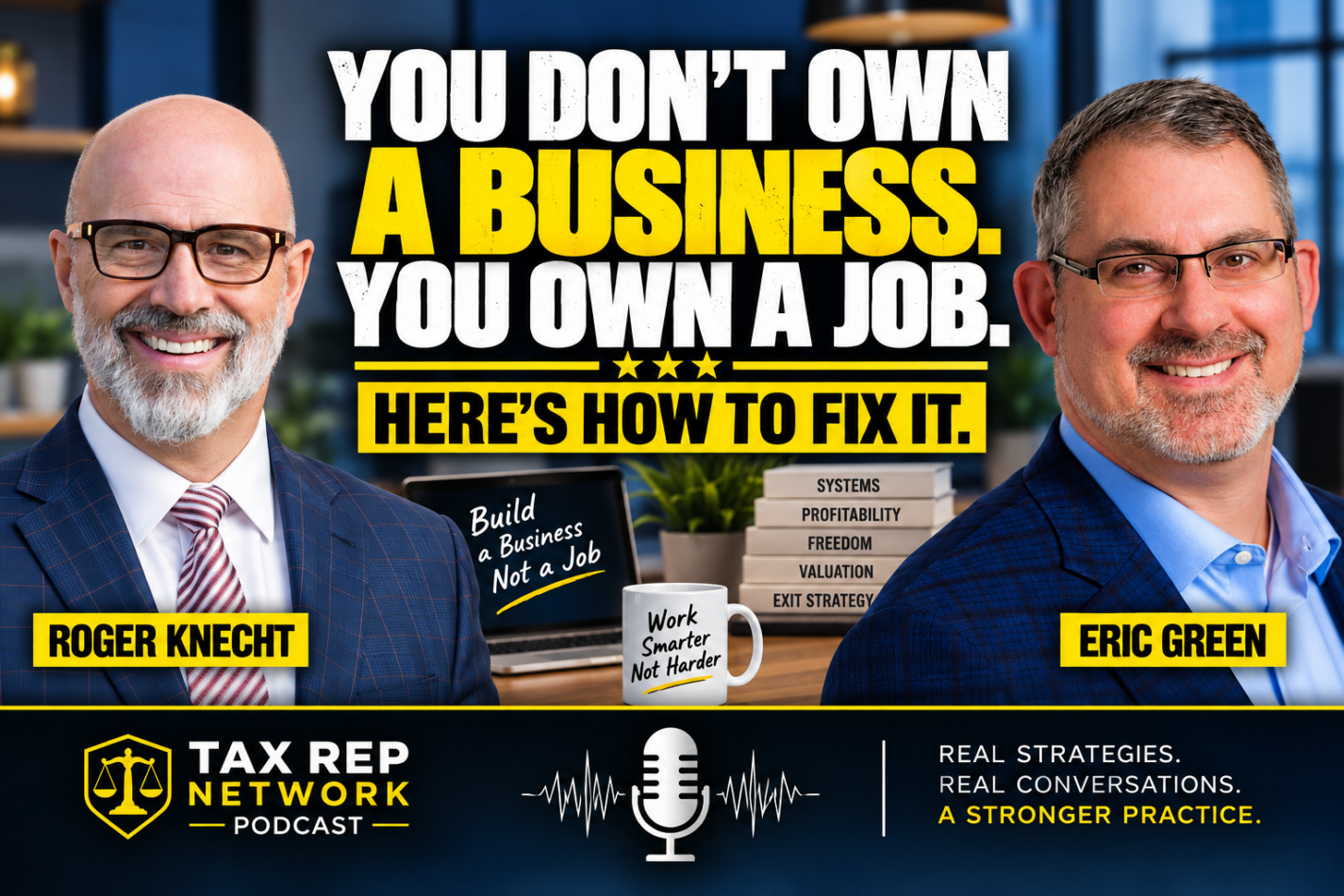
You started your own accounting firm for freedom, flexibility, and financial success. So why are you working harder than ever?
In this episode of the Tax Rep Network Podcast, Eric Green sits down with Roger Knecht, CEO of Universal Accounting, to tackle one of the biggest obstacles preventing tax professionals from growing their firms: the inability to get out of the day-to-day work.
If you’re still preparing every return, reviewing every bookkeeping entry, and handling every client issue yourself, you haven’t built a business. You’ve created a job you can’t escape.
Roger explains how to break that cycle by developing a team that can handle the work without requiring you to become a full-time trainer. From turning inexperienced hires into productive tax preparers to helping existing employees become Enrolled Agents, Eric and Roger explore how investing in your staff can unlock higher-value IRS representation, advisory services, and real practice growth.
Discover how structured training, smart delegation, and just one hour a day of employee development can help you build a firm that operates without depending on you for everything.
The goal isn’t just to make more money. It’s to build a business that gives you your life back.
Learn more about Universal Accounting’s training programs at by calling 435-344-2060.
Watch the episode here
Listen to the podcast here
You Don’t Own A Business. You Own A Job. Here’s How To Fix It With Roger Knecht
I am joined by my friend Roger Knecht. Roger is back again. Roger is the CEO of Universal Accounting. They are probably one of the best training organizations in the country from tax, bookkeeping, getting your EA, and growing your practice. They run GrowCon every May. We’re going to be there again. It’s in Scottsdale, which is very exciting. Roger, thanks for being back.
Thank you.
I want to talk about a topic you’re going to be presenting and talking about at our Summit in November, which is this issue. We run into a lot of this with our tax rep members. Are people thinking about it? I see the opportunity. For me, it’s the IRS doing representation, but I want to do more advisory. I want to do CFO services.
I want to do more financial and estate planning stuff with my clients. They can’t get out of their way because they’re always inevitably reviewing bookkeeping or doing the returns. They can’t free themselves of the grind to focus on that, the higher end work, which is where you probably have more fun. You make more money. Do you run into that? How do your folks help people stuck there?
Escaping The Day-to-Day Compliance Trap
First of all, you’ve described it exactly as I see it. A lot of people do experience exactly what you’re describing because, as they grow their businesses, they see opportunities to service their clients better, get into advisory, the tax resolution type services where they can be more creative and pay a lot more. They keep getting dragged back into the more compliant type work of tax preparation, finance, and, let’s say, the bookkeeping.
What we’re trying to do as an accounting school is liberate them. Give them a pathway so that they can see a way towards doing that. What it involves is obviously getting someone else trained to do the work. You run into a common scenario, which is, if I want it done right, I want to do it myself. As an account entrepreneur, one of the things we start to emphasize is, you need to get out of your way, as you just mentioned. One of the things we have to do is now provide that pathway.
As a school, what we’re trying to do is work with firm owners to recognize that they can identify in the firm individuals that they can, in fact, train, but they don’t have to share the burden of being the trainer. They’ve got things they need to move on to. As a school, we go in and help that firm get those individuals who perhaps have been doing bookkeeping for some time to be trained in tax preparation or vice versa. The other thing that is very common that I see quite often is you identify a family member, a friend, a good individual that has potential.
They’re clearly good workers. They’re very productive. They just lack the skills and experience in, let’s say, tax preparation. That’s a skill that we can train as a school that we’ve been doing since 1979. What we do is we basically help you, as a firm owner, get that individual up to speed so that they can do the tax preparation you are familiar with, so that you can move on to these other things that you’ve explained. What we’re trying to do is basically empower the tax owner, the firm owner, to now grow their business as they’d like to with a pathway to achieve that doesn’t involve their time. That’s what we’re talking about.
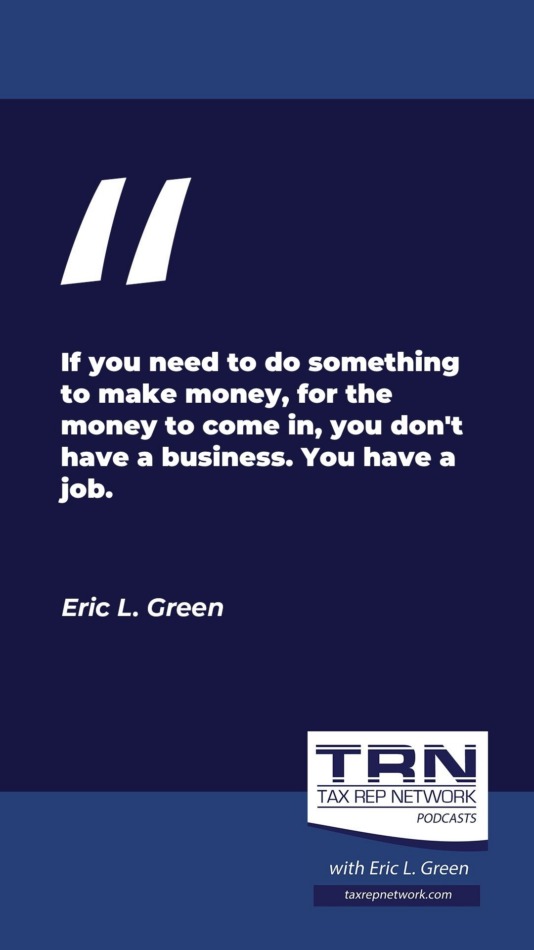
That is the difference between having a job and having a business. You get to that, which is people become self-employed and they’re just doing all the stuff that they used to do elsewhere. What some of these financial gurus do point out, which is very true. If you need to do something to make money, for the money to come in, you don’t have a business. You have a job. That’s what you’ve done. You’ve traded one job for another. In fact, it’s the worst job you’ll ever have. At least the other job you could take vacation and take a sick day and get paid.
When it’s you, the bastard you have as a boss doesn’t pay you when you take a day off because of no money. One thing I wonder. Do you find people reach a breaking point and they come to you more out of desperation? are there folks that are like, “I have got to become a business owner and I see the issue. Now I found someone Universal that can get my people trained to free me from that?” Is it a combination of both?
It’s a combination of both, but I’m going to definitely agree with you. It’s one more than the other. The one that typically shows up is the breaking point. They’re at their wit’s end. They don’t know what to do. This is then an obvious solution. The other is rare, but it does happen, which is that proactive account-trepreneur who has that entrepreneurial mindset. They’re looking for a pathway forward that’s going to accelerate their ability to achieve what they’re trying to do. We’re clearly part of that equation.
Let me answer your question in a unique way, because there is a process to this. I don’t want to make this seem difficult. It is simple. Not easy, but simple. It’s, first of all, three things. One, whether you’re a solopreneur or you’re, let’s say, a midsize firm. The first thing you have to understand is you’ve got to document the processes. Before you take a task and ask someone else to do it, you’ve got to get it out of your mind and document what it is that’s being expected.
The Simple Formula To Delegate Without Risk
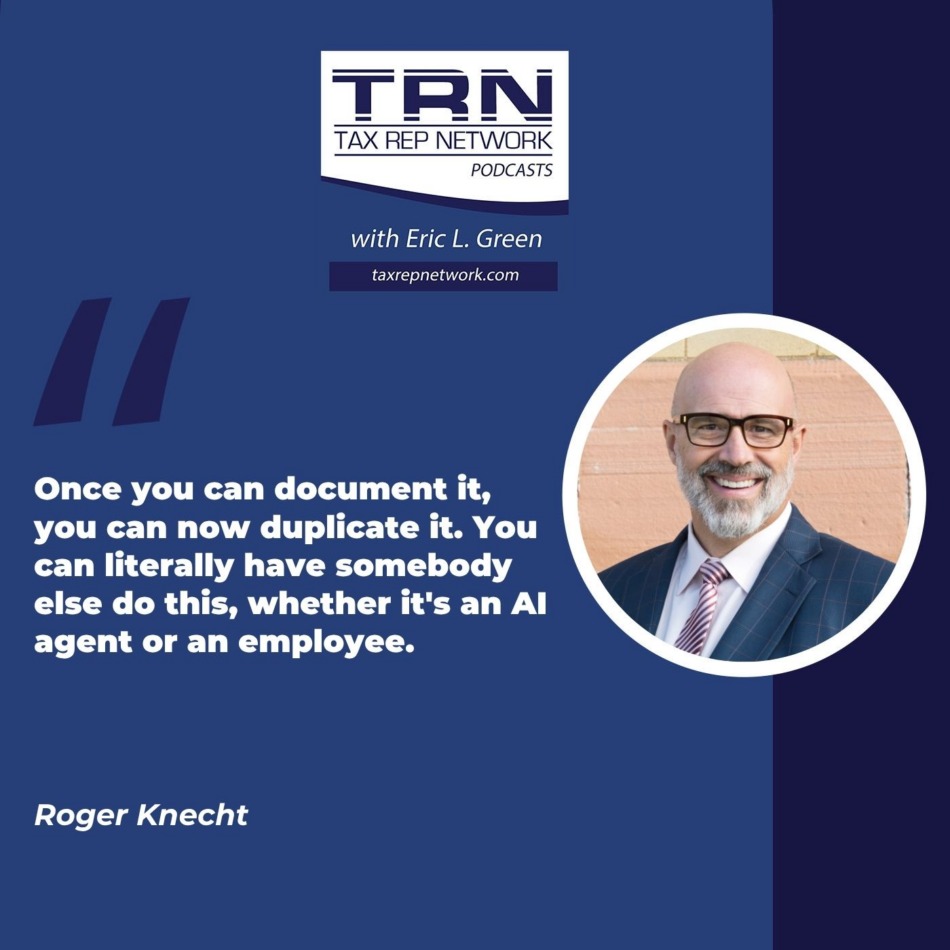
Once you can document it, you can now duplicate it. You can literally have somebody else do this, whether it’s an AI agent or an employee. Either way, you can now duplicate what you were doing because you’ve recorded the steps. The next part is the more important step. It’s once you get to the point that you feel confident in that ability to be done, whether through AI or an employee, you’re at a point now where you’re able to now delegate.
What we’re doing is we’re giving you that ability, that confidence to delegate. As it relates to working with employees, what we’re trying to do now is enable you to take individuals who may not have that skill and experience and give it to them. Let me explain how that works. If you’re a firm owner, you have three options ahead of you, in my opinion. One, you can train the next person. That’s obvious. We’re all experienced training individuals.
In our careers, that’s something that we’re able to do, but do we have the time, as we’re running our business and doing the other things we want to, to be the trainer? Oftentimes, most firms do not have in-house trainers. We come in as a school and we have that ability to train the individuals. If you want to train, we can give you the curriculum. You can teach the classes to your staff, and that’s totally fine.
Outsourcing Employee Development Without Firm Bottlenecks
Most firms don’t have that luxury. What they do is they work with us where we have a point of contact within the firm, and enable them to now work with these new people, get them up to speed, and typically once a week do a review with the individuals going through the training to just say, “Here’s how we do it in our office. This is the way we would expect it to be done, answer questions, remain that point of contact within the company, while we as the school do the heavy lifting. Whether it’s through the video instructions, workbooks, assignments, to train the individual to do the work.”
Now, here’s the beauty of it. Since we’re a school, even if you don’t have the ability to do that much, we can do all of it to the point that we put them through the training, whether it’s helping them become, let’s say, tax professionals doing individual returns and report back to you based on their exercises, exams, and quizzes, how well they’re retaining the information. As the employer, we can tell you whether or not they’re understanding this.
Oftentimes, what the employers do is in the first 90 days of employment with a new hire, whether they came in and interviewed well saying, “I’ve done this. I know this,” we don’t want to trust that. We want to put them to work as quickly as we can, but train them how we expect it to be done. We are part of that first 90-day process to ensure that they, in fact, have the skills, the knowledge, the understanding that we would expect them to have. That’s the beauty that we bring to the equation, because as a school, we’re accelerating that ability of putting that person to work. That’s what we’re trying to help.
I’ve run into that a lot, even for myself many years ago. I got out of law school. I’m interviewing with firms. Ultimately, I went to a big firm but some of the smaller firms I interviewed with, you’d have partners saying, “I’d love to have you come on.” I have no time to train somebody. This is often like this small firm a meme. You’re either part of the solution or part of the problem, and you’re probably part of the problem for the first four years.
At small firms, since people tend to leave and go set up their own shop or whatever, what you find is most small firms don’t want to bring people in and train them. They don’t have time, and because of that, they can’t get out of their own way. They can’t grow. They can’t free themselves because they can’t find people. Even if they find people, they can’t train them properly. For the folks reading, this is an opportunity to either take people you already have that need to be trained, or even if you bring in somebody new, Universal trains them so you basically are not back.
At the end of this, you have an employee who is trained to do tax preparation or you guys also do training in bookkeeping who is trained and can then hit the ground. Meanwhile, you’re monitoring their progress. I like the class aspect of it. Almost like the university aspect of it, because there’s a reporting back that you’re investing in this person. It’s a real investment both in money because you have somebody who you’re going to make money with as they do the work.
It’s also the opportunity because I just freed myself. If I can free myself, now I can go do higher end work that I want to do. Advisory or whatnot, IRS rep. It’s a win-win because that’s a big sticking point. I’d love to do this. I’m just too busy. Why am I too busy? I can’t get anyone to help me. Why? It’s because even if I find somebody, I have no ability to train them. No time.
Let me address two things that are very understandable. One, you have the best of intentions of wanting to train the individual, but you’ve never put together a curriculum. You don’t necessarily have a manual or a module that you can take to this individual. You have, in your mind, the tasks that you perform and the steps that you follow. We have a curriculum to teach them not just the steps, but more importantly, the concepts.
What is a debit? What is a credit? What’s tax law? As you go through that, we’re basically checking all the boxes, as you would expect, to understand not just the steps but the theory or the thought behind why the steps are so important. That’s great, but here’s the thing that is also very relevant to this part of the conversation. How do you get the employee to buy into this? How do you get them to go through the program?
Incentivizing Team Members To Master Core Skills
The thing that is very essential is what some creative firms have done to motivate their employees. Some do a scholarship-type program. You go through and complete the curriculum and pass it. We’ll then give you a pay increase upon completion, or we’ll reimburse the tuition, or we’ll pay half of the tuition. You pay it upfront, we’ll pay half of it or all of it later on. There’s creative ways that firms have used to get the buy-in of the employee to simply say, “We’re not just trying to give you training and cross our fingers and hope you do it. More importantly, pay attention.”
We’re going to say, “You do this. You pass. You get a good grade in the end. We see that you took it seriously. We’ll reimburse the tuition.” We’ll, more importantly, give you a pay raise or maybe give you a bonus upon completion. There’s a lot of creative things that firms have done to ensure that the person does the program, pays attention, and gets fully vested in the process. In the end, you win. You’ve got an employee who feels like you invested in them.
That you’ve valued them enough that you were able to invest in them, giving them the skills they need to accelerate or excel in their careers. That’s huge. The employee feels like they’re important. At the same time, they realize that there’s some skin in the game. I’ve got to do this well if I want to get, let’s say, the bonus at the end of, say, $250 if I finish and pass this. Those things matter from their point of view. They matter from your point of view.
What we’re trying to do is just create an ecosystem that enables you to get what you want. A capable, competent, skilled employee that you can now delegate certain tasks to and allow you to free yourself of those things that you would like to no longer do and do what matters most. These higher-end paying opportunities that are more creative and, most importantly, revenue-generating.
What does this look like? Roger, I’ve got two employees. I would like to get them up to speed. How does it work? What is the runway for this in terms of starting? What does the curriculum look like? I’m interested in this. What are we signing on to?
Let me try and keep it simple. I don’t want to overwhelm everyone. We’re a school, so we view things as tuition. You would expect, as a student, to go through that type of an experience. Here’s how it works. The firm has to identify someone in the organization that’s going to be our point of contact. Who are we going to work with as we implement this with the employees? That individual is the first student. Now, they may or may not be the ones going through the training. That’s another discussion.
My point in bringing this up is that the first individual is the person who we enroll. When we enroll them, they now create the library that the firm is able to use. Here’s what I’m trying to say. We as a school have a variety of curriculums, courses, and training that we can offer. By identifying that library, we’re able to enroll that first individual into what the firm would like others to be trained in. Now, once that first person is enrolled in the specific courses that the firm wants the rest of the employees to be exposed to.
After that, it’s a small fee that we then charge per employee that you’re able to, as a firm, identify which of the library courses that employee would like to be exposed to. Let me just give you an example. Let’s assume that we want to train people in both bookkeeping, tax, and advisory services. That’s the library that we enroll the very first person in, those three programs. However, the first employee, we want them to go through the bookkeeping training. Phenomenal. One fee. They get to decide what, as a firm, they want that employee to go through. We assign it, and they start going through the course.
The other employee, same fee, but we don’t need them to do bookkeeping. We want them to do tax preparation. That’s what we assign that individual. Let’s assume it’s a year from now. This employee has done very well. They’ve excelled in what we’ve expected of them. In fact, we would like to take that bookkeeping employee and have them help us next tax season. Wonderful. No additional cost. The library exists. We just go in and, per your request, assign them now the tax training, and they continue on with the curriculum, doing what you would now like them to do from the library that the firm has.
The One Hour A Day Employee Training Strategy
We try to keep it very simple. The library is meant to be the core thing that the individual at the firm that we work with has access to everything that they want. They just piecemeal assign what they would like the individual employees to be trained in. The courses themselves are designed to be done one hour a day. We’re not asking that they spend 4, 6, or 8 hours. We’re saying one hour a day. They go in, do the work, and then they can go to work and do whatever else is expected of the employee. Internal training, work, get things done, make money for the firm, but we’re asking for one hour a day.
With that one hour, we can get people trained in 2 weeks, 4 weeks, or 6 weeks. The programs are designed to be done in 4 to 6 weeks, but easily you can go through these programs faster. Some people do two hours a day. The whole goal here is at the end to have a common training that all the employees within the firm have been exposed to. They have a similar vocabulary. They have similar reference points to basically say, “Do you remember that assignment? Do you remember this thing? That’s how we’re going to do it here.”
That common vocabulary trickles down into the culture of the firm. Now you’ve got everybody trained on a very similar platform and process that you’re able to now exploit to the benefit of your clients and what you’re doing as a business. That’s the experience. We as a school work with a key contact at the firm. We identify what the firm would like to have people trained on. That creates the library, then we just start putting people through the classes.
Now is the perfect time to do this for tax season.
One of the things that you can look at is take, for example, you have individuals that you’d like to be geared up for individual tax preparation. They could be done and ready in 2 to 3 weeks. That’s easy. Two to three weeks, they’re up and trained. They’ve got the skills that they need. You’re able to now familiarize them with your internal processes, the software you’re choosing to use, whatever the case may be. In 2 to 3 weeks, individual tax preparation, and they’re good to go. Some people, if they don’t have experience in accounting and so forth, it might take them another week. The point is, is it’s very doable at this time of year to get everything up and ready for tax season.
Developing Enrolled Agents To Multiply Capacity
What I like about this, for the folks reading, most of my staff did not start as accountants or EAs. They grew up and went and got it. We just hired smart people. Eventually, in doing some of the rep, they went and got their EA, which, by the way, you guys do. You can go to the commercial and go through the course, and you can get people. They’re enrolled agents. Now, I have EAs. I don’t have to spend hours on the phone with the IRS. They do. They call. First of all, lower billable rate in terms of profitability on the case.
Through time, I have some serious chief lieutenants who could run if, God forbid, I go down for surgery and I’m out for a month. The machine just keeps running. I have Amanda, Christina, Maggie, and Savannah. The machine rolls on. The Patriots next man up. The machine goes on without me. I’m sure they’ll check in with me from time to time, but that’s the reality. You’re talking about bringing someone up. Now you get them trained for tax season. They free you up. If they’re good, we provide bonuses. Your pay is going to go up. Get your EA. They were like, “I’ll get my EA.”
I have EAs. Now they’re on the phone with the IRS. As an example, we had about 180 ERC denial letter cases come to us. A lot from referrals from one real big company. I took a couple of hearings. They handled the rest and won some that were great. We’d all be reviewing all of them. We should talk to the client. They got the first two quarters and they didn’t qualify in the third. They talked the appeals officers into them.
The beauty of what you’re describing is the fact that you took individuals with experience and gave them reason to continue with their career. They saw it as a profession, not a job. You took that tax preparer and you helped them see that there’s a pathway to becoming an EA. Whether it be our AFSP course or our EA prep course. Those curriculums exist as a school to help them basically excel as a professional. That’s one of the things that I’d like to emphasize is you’re pointing out that this is an attitude towards, “I see myself as a professional. What more can I do to excel in this career?” That’s beautiful, and we want to be part of that process.
For the folks reading, we’re talking about a couple of different things here. First of all, to free yourself up. If you have staff or hire staff, get them trained, give them the train they need to free you up. Number two, you’re laying the groundwork, whether it’s from bookkeepers and in tax prep. Again, I’m thinking through the IRS rep lens. Let them take the next step. They can go get their EA with Universal, go through it, and get that. Now, like me, it’s a force multiplier.
We can handle multiple hearings going on at the same time with the IRS. I’ve got people that do that. We’re in a niche, IRS rep. There’s no shortage of work with the automation at the IRS now and everything else. We just looked at it. We’re getting, on average. October to date, we’re getting six new referrals a day.
Some of them are too small or it’s something we don’t do internationally. We referred somewhere else, but even if we keep half of them, for us to take 60 new cases a month. It’s a lot of cases, but we can do it. We can handle it. This is the opportunity. If people are not familiar with Universal, Roger, and they should be. By the way, they should go to GrowCon, which I’ve never been to in person until this past year.
t’s a fun conference. It’s well done. Everybody there, you can tell, is motivated to get to the next level. I speak at a lot of conferences. I’ve been at the biggest ones as speakers. We run them. It’s very well done. In terms of going and checking out Universal, just hit the website, UniversalAccounting.com. Where would we send people?
UniversalAccounting.com is a great place to start. That’s where people become introduced to us. We have a great deal of free resources that are available there. It also has reference to not only my show, but GrowCon, as you mentioned. The other thing I would encourage is if you’re interested in looking at the particular programs we offer, is to go to UniversalAccountingSchool.com. There, you can learn about the various courses that we provide.
I would particularly suggest that in the navigation, you go to our courses, and you’ll see things related to CFO and advisory, tax preparation, advisory services, and bookkeeping. You can just go in there, and it speaks of the various classes that we provide. More importantly, just as easy, give us a phone call. You can call us at (801) 265-3777. We can get you to the right person and help discuss your situation. I love hearing what people’s experience is, what their background is, but more importantly, what their goals are, and then we generally can just point them in the right direction and say, “This is what your next path or step would be to achieve what you’re trying to accomplish.”
Your students are very motivated. I know with rep, we’ve had a number of them come in. I’m always impressed by you. You’ve managed to attract people that they get it. They see the opportunity and they understand. I’ve had Rick Wells on. Rick is a friend of mine and a financial advisor. He’s a retired lieutenant colonel in the Marines. He talks about a game plan. Basically, you have to commit at some point to make the climb. You’re at the foot of the mountain. You see what you want at the top of the mountain. How many people just never bother trying to make the climb?
You’ve got to make the climb. He said, “You can go up faster until you find mentors along the way. You find courses. You educate yourself, but you have to invest in yourself.” As a firm owner, I would argue you are investing in yourself by having better staff that free you up. First of all, you can multiply what you’re doing. Two, it frees you up to go do the work you want to do, even if I don’t want to do any different work. I just want to get my life back.
I used to add a former partner, long since retired, who would tell you, “It’s overhead.” Jeff and I would have arguments with him. It’s not overhead if it benefits us. It’s an investment. He didn’t get it. He’s the person to say, “We could get a computer and a better computer would be faster. We’d build more,” but he couldn’t get over the cost of the computer. That’s a tough mindset to deal with. If you get it, this is the way to go.
Universal is a great place to put your people, get them trained, and get them up to speed. For those of you coming to Summit, Roger will be there. We’ll be at the Drury November 2nd to the 4th. There are some seats left in the room. We are not live streaming, Roger. We decided the experience is being there. You got to be there. We’ve had some people disappointed saying, “I just want to get on the live stream.” Not live streaming. Sorry.
The Power Of In-Person Industry Networking
I do want to address that because I do feel that people want, let’s do the remote access. One of the things I can’t stress enough is when you come to the event, you’re able to step away from the daily routines. You’re not multitasking, watching it on your computer, then at the exact same time, trying to listen. You’re all in at the conference.
There’s so much that happens in between the sessions, the conversations, the people you meet, those things that take place at lunch and dinner. These are all things that never get experienced at the remote view level. This virtual access to a conference, it’s hogwash. You’re placating yourself, believing you’re getting the information while you listen and do your job, and you don’t apply anything. You need to step away, remove yourself from that experience in your office, and go to the venue. It’s not just the sessions. It’s everything else that’s going on around it. That’s where the benefit is. I completely agree with you and I applaud you for removing that option.
It was all to your point. We got caught up. We can make more money on the live stream because we don’t have to feed them. They don’t have to be in the room. What I began to get a sense of is there are people that “are at a summit every year online” and but don’t get the experience. It’s silly to say, they’re missing the magic.
They are.
Also, the conversations. I’ve gotten to know some of my members. At night, there’s a group of us that are cigar people. We sit out back. It’s on the water. They’re right by the drawer. You can sometimes see the fireworks from Disney. People just walk by and sit down. We have these very interesting conversations. RepWorks, our software, came from conversations with people at Summit. It’s great if we could automate this. I finally was like, “We can do that.”
Again, you said it’s the stuff that’s not necessarily in the classroom but the conversations afterwards, sitting and talking to people. It’s the experience. Even though we lose that revenue stream from the webcast, the experience will be better. Plus, the other thing is we’re not playing to the online audience, which does detract from the folks in the room. We’re getting questions from the online audience. They can’t hear someone’s speech. I hate to say this, but there’s a lot of nonsense that goes on around the live stream. Not having it is going to be liberating.
People will make the case that they can’t travel. It conflicts with their different things. You’re always going to have somebody that would benefit from the virtual. I’m not saying it’s a zero-sum game. There’s a benefit to it, but it does not compare to the live attendance. It does not compare to all the extracurricular things that occur at an event beyond the presentations themselves. If you’re looking for an, let’s say, an exponential increase as to the value of having participated at the conference. It’s attending and showing up. I definitely want to encourage that.
I couldn’t agree more. Now is the time. If you either have staff or getting staff, get them in. I have to tell you, even if you have staff and they’ve done some return prep. This might be a good time to sharpen their skills and get better quality work out. It’s the time to do it. Gear up. Make this coming tax season the most profitable ever and start getting your life back, and elevate your practice or just get your life back. Roger, thanks for taking the time. I’m going to see you in a few weeks in Orlando. It’s going to be great. Go check out Universal Accounting, and hopefully, we’ll see all of you and you can go meet Roger at the Summit in Orlando.
I look forward to it. Always remember this, accounting success is universal.
On that note, Roger, thank you. Everyone, thanks for tuning in on this episode.
Important Links