



More employees. More software. More clients.
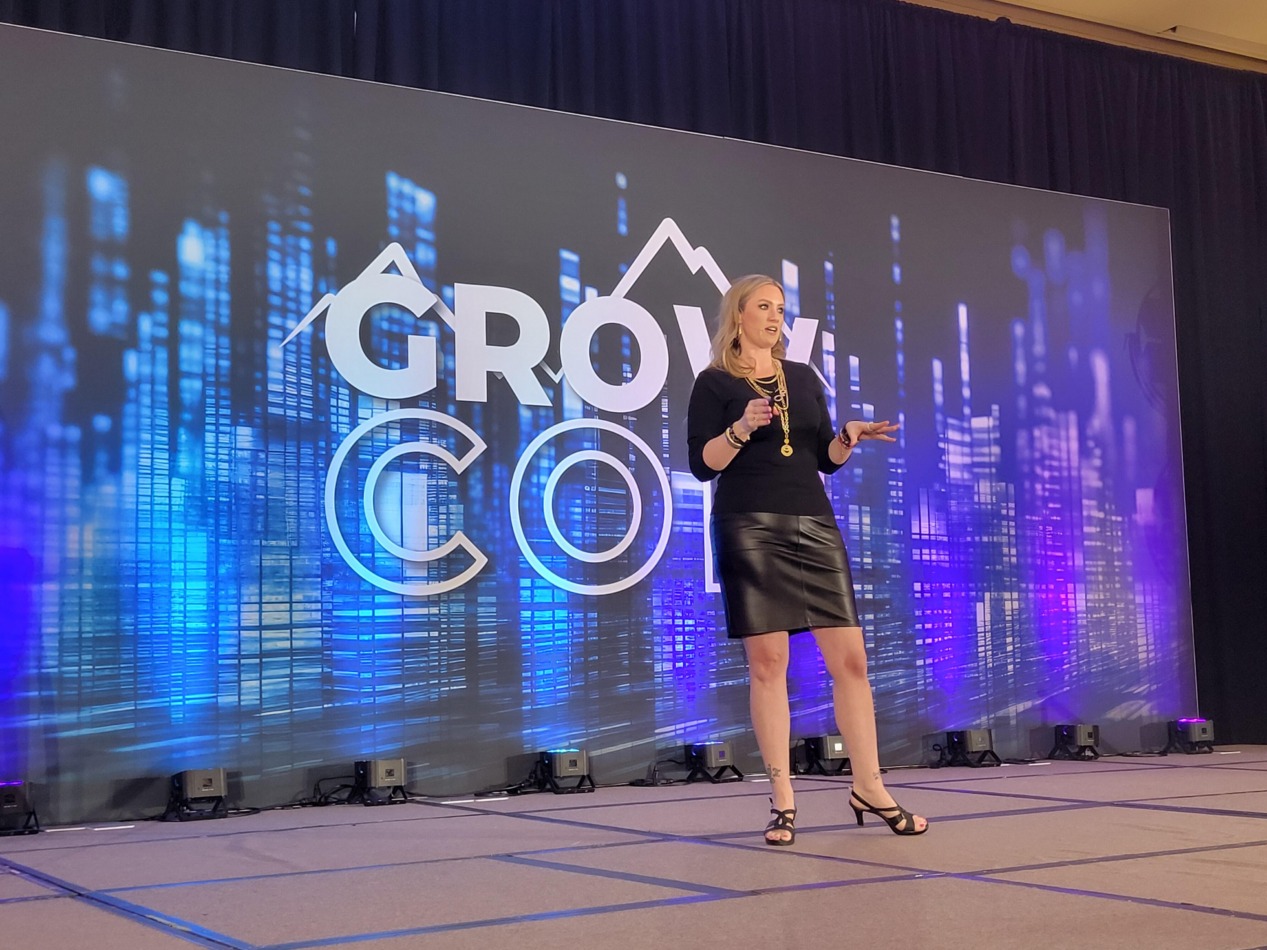
For many accounting firm owners, those look like signs of success. But in her presentation at GrowCon 26 in Provo, Utah, entrepreneur and business strategist Sharrin Fuller challenged attendees to measure growth differently.
“The number of employees you have does not determine how successful your firm is. Your ability to step away and let the firm keep running does,” Fuller said.
Fuller, of Glass Wallet Ventures, LLC, brought hard-earned experience and a cutthroat approach to scaling an accounting firm to her presentation, “Scaling Down to Scale Up: Why Fewer People and Smarter Systems Make a Stronger Firm.” Having built and sold two seven-figure firms, she shared a candid account of how hiring more people failed to solve her operational problems—and how rebuilding her systems changed the business.
When Hiring Becomes a Substitute for Fixing the Process
Fuller asked attendees to consider a familiar response to an overwhelming workload: hiring someone to solve the problem.
But does the problem actually get solved?
At one point, her firm had six full-time employees, four part-time employees, and two contractors. Despite that headcount, the team was still drowning in work. Payroll alone consumed approximately 80% of gross revenue, she said, before software expenses or her own compensation.
Fuller installed a tracking software on her employee’s company issued laptops. She was shocked to find how little time they spent working from their remote setups. One employee was working an entirely different job on company hours and hardware. Everything had to change.
She had also invested heavily in automation, accumulating roughly 250 Zaps on Zapier. Yet she was missing something more fundamental: clear, repeatable processes.
Looking back on the many people she had hired and subsequently let go, Fuller recognized a difficult truth. She was the common denominator.
“I was just assuming that I had hired amazing people and they were going to do amazing things. If I treated them right, they were going to treat me right, right?” Fuller asked the audience.
When the monitoring software revealed employees spending paid time on unrelated activities, Fuller took responsibility for the environment she had allowed to develop.
“I created that. Every. Single. Piece. Of. It,” Fuller said.
Her message was about leadership accountability. Good intentions, generous treatment, and sophisticated software do not establish clear responsibilities, measurable expectations, or a reliable way to deliver client work.
Simplify. Systemize. Grow.
Fuller’s framework put those steps in a deliberate order.
Firm owners want growth. But when they expand before simplifying and documenting their work, they can create more complexity than the business can handle. Hiring into that confusion may leave a new team member struggling with the same broken process.
Fuller eventually reduced her team dramatically. In her account, the smaller operation became stronger because the work was supported by better systems.
She encouraged owners to examine capacity and productivity rather than assume every role requires a traditional 40-hour workload. She also offered $200,000 in annual revenue per employee as a benchmark she uses to evaluate staffing efficiency.
The broader lesson: understand what work needs to happen, how long it should take, and what results each role is responsible for before adding another position.
The “Clone and Conquer” Method
To make expertise transferable, Fuller recommended a straightforward approach:
Record it. Refine it. Release it.
Using tools such as Loom and Scribe, owners can capture a process while completing the actual work. They can then refine the instructions, clarify decision points, and prepare the task for someone else to handle.
This turns knowledge held in one person’s head into something the business can use repeatedly.
For an accounting firm, that might mean documenting client onboarding, a monthly close, payroll procedures, or the preparation and delivery of recurring reports. The objective is consistent work that another qualified person can understand and complete.
Fuller’s preference is to avoid repeatedly rebuilding the same solution. Once a recurring task is understood, create a dependable process and automate appropriate steps.
Build a Firm Someone Else Can Run
Fuller connected those operational improvements to the eventual sale of her firm.
She reported selling for twice annual revenue and attributed the result to the systems she had established. That was her experience, rather than a valuation promise for other owners, but it illustrated her central point: a business becomes more transferable when its operations can function without its founder.
According to Fuller, the documentation was thorough enough that she could step away without a transition period.
She also discussed how longer-term client agreements can support predictability and how a more disciplined hiring process can improve team decisions. Her approach to a second interview involves three interviewers, all of whom must agree on the candidate. A “maybe” counts as a no.
Across these examples, the same principle emerged: build clarity into the business before asking it to carry more.
Rethink What Growth Looks Like
Fuller’s presentation offered a challenging question for accounting firm owners: Are you building an independent business, or adding more people and tools to an operation that still depends on you?
Sometimes, strengthening the firm means reducing complexity before pursuing the next stage of growth.
Thank you to Sharrin for sharing these valuable insights with the attendees at GrowCon 26.
Want the full story behind Sharrin’s transformation? Purchase the video of “Scaling Down to Scale Up: Why Fewer People and Smarter Systems Make a Stronger Firm” to hear her presentation, as well as the other 14 excellent presentations shared on stage in Provo last year.
The insights don’t stop there! GrowCon 27 will be held in Scottsdale, Arizona from May 3 to 5 next year. Tickets are available now.