


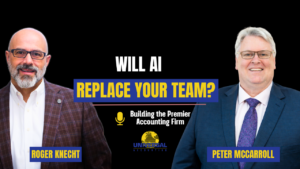

Artificial intelligence is no longer a distant development that accounting professionals can afford to monitor from the sidelines. It is already changing how financial data is processed, how quickly reports can be produced, and what clients expect from their accountants.
Peter McCarroll, founder of The AI Accountant, believes the pace of change will be dramatic. He warns that accounting firms may have only one or two busy seasons left before their practices begin to look fundamentally different. Firms that wait until 2028 to respond may discover that their clients, competitors, and technology have already moved on.
McCarroll shared his insights with Universal Accouting Center President Roger Knecht on Roger’s podcast, Building the Premier Accounting Firm.
That prediction may sound alarming, but it also points to an enormous opportunity. AI can automate many of the repetitive tasks that have consumed accounting professionals’ time for decades. The firms that benefit most, however, will not simply use AI to do the same work faster. They will use it to change the kind of value they provide.
Accounting Is Moving Beyond the Rearview Mirror
Traditional accounting has largely focused on the past. Financial statements, tax returns, and reconciliations tell business owners what has already happened. That historical information is essential, but it often arrives too late to influence the decisions that produced it.
McCarroll compares this model to driving while looking in the rearview mirror. The accountant can describe where the business has been, but the owner still needs help deciding where to go next.
AI is accelerating a shift from the rearview mirror to the dashboard. Modern tools can categorize transactions, identify irregularities, summarize results, and update financial information much faster than traditional workflows. AI-native platforms are moving the profession closer to a “zero-day close,” in which financial information becomes available almost immediately rather than weeks after the end of a reporting period.
As access to real-time information improves, simply delivering reports will become less valuable as a standalone service. Business owners will still need someone to interpret those reports, explain what the numbers mean, and help them make better decisions.
That is where the accountant’s role begins to move from recorder to navigator.
The Future Accountant Is a Navigator
Many business owners currently interact with their accountant only at tax time or after a financial problem has already developed. In that model, the accountant acts like a pit crew: called in periodically to complete necessary work before the owner returns to running the business alone.
The future model is much more collaborative. The accountant sits beside the owner and helps navigate the road ahead.
That might mean helping a client answer questions such as:
- Can the business afford to hire another employee?
- Why is cash flow declining while revenue is increasing?
- Which products or services generate the strongest margins?
- What financial warning signs should the owner watch?
- How should the business prepare for slower months?
- What must change for the company to reach its growth goals?
Software can organize the underlying data, but it cannot fully replace the trust, context, judgment, and accountability involved in those conversations. The more efficiently AI produces financial information, the more important it becomes for accountants to develop the advisory skills needed to turn that information into action.
The Three Levels of AI Adoption
Accounting firms often begin their AI journey by looking for quick efficiency gains. That is a useful starting point, but it is only the first of three levels of adoption.
1. Efficiency
At the efficiency level, firms use AI to complete existing work faster. The technology might assist with data transformation, complex journal entries, document summaries, client communication, workflow documentation, or research.
These improvements can reduce manual work and help firms respond to pricing pressure. They can also give employees more time to focus on exceptions and client needs. However, efficiency has a natural ceiling. A firm can only remove so many hours from an existing process.
2. Strategic Thinking
At the next level, firm leaders use AI to think more strategically about the practice itself. They can evaluate workflows, identify bottlenecks, document institutional knowledge, analyze service profitability, and consider how the firm should position itself as client expectations change.
This requires leaders to ask bigger questions. Which services are becoming commoditized? Where does the firm have specialized knowledge? What information do clients need but rarely receive? Which processes should be automated, redesigned, or eliminated?
AI becomes more than a production tool at this stage. It becomes part of the firm’s planning process.
3. Revenue Growth
The greatest opportunity may come from using AI to create and deliver new services. Faster access to organized financial information can support cash-flow planning, forecasting, KPI monitoring, profitability analysis, scenario modeling, and other Client Advisory Services.
These services address problems that business owners are willing to pay to solve. Instead of competing primarily on the price of a tax return or bookkeeping package, an accounting firm can compete on its ability to help a client make better decisions and build a stronger business.
Efficiency protects margins. Advisory creates new value.
AI Will Change Accounting Jobs, Not Eliminate the Need for Accountants
It is understandable that accounting professionals are concerned about displacement. AI will almost certainly reduce the amount of human effort required for lower-value, repeatable tasks. Straightforward data entry, basic reconciliations, and simple tax preparation are especially likely to become increasingly automated.
But automation does not remove the need for professional oversight. AI-generated work must still be reviewed for accuracy, completeness, context, and compliance. A confident answer from an AI system is not necessarily a correct one, and financial errors can carry serious consequences.
This creates an emerging role that McCarroll describes as the “accountant agent manager.” Rather than personally completing every step of a process, the accounting professional may supervise specialized AI agents, investigate exceptions, verify final outputs, and communicate the results to the client.
In practical terms, the professional remains accountable while the technology performs more of the production work.
This shift can also create a stronger career path for bookkeepers, tax preparers, and staff accountants. When less time is consumed by transactional work, professionals have more capacity to learn the client’s business, recognize financial patterns, lead planning conversations, and move up the “CFO ladder.”
The professionals who succeed will combine technological fluency with distinctly human capabilities: skepticism, judgment, empathy, communication, and strategic thinking.
How Accounting Firms Can Prepare Now
Preparing for the accounting firm of 2028 does not require automating everything at once. It does require deliberate action.
Firm owners can begin by identifying their most repetitive workflows and documenting how the work is currently performed. They should then determine where AI can assist without compromising accuracy, privacy, security, or professional responsibility.
Every AI-supported process should include clear review standards. The firm must know who is responsible for checking the work, how exceptions are handled, and what information should never be entered into an unapproved system.
At the same time, firms should invest in the human side of transformation. Team members need opportunities to strengthen their communication, analysis, and advisory skills. Client conversations should expand beyond deadlines and deliverables to include goals, risks, cash flow, profitability, and future decisions.
Finally, firms should test new advisory services with a small group of suitable clients. A limited pilot can help the firm refine its process, clarify the outcome it provides, determine how the service should be priced, and gather feedback before a broader launch.
The Real Risk Is Standing Still
AI is not simply adding another tool to the accounting technology stack. It is changing the economics of traditional accounting work. As machines become better at producing financial information, the profession’s value will increasingly come from reviewing that information, interpreting it, and helping clients act on it.
The accounting firms that thrive will not be defined by how much historical work they can process. They will be defined by how well they use technology and professional judgment to guide clients forward.
For bookkeepers, tax preparers, and accountants, this is the moment to begin making that transition. Learn how the tools work. Modernize outdated processes. Build safeguards around AI-assisted work. Most importantly, develop the advisory abilities that allow you to turn accurate numbers into meaningful business decisions.
Universal Accounting Center’s Profit & Growth Expert program helps accounting professionals build the skills needed to offer CFO and advisory services to small-business clients. By combining a solid accounting foundation with forward-looking guidance, professionals can remain valuable even as the tools used to produce the numbers continue to change.
AI may reshape the accounting firm, but the future still belongs to professionals who can help business owners understand where they are, decide where they want to go, and navigate the path between the two.