



bookkeeping businesses

Starting a Bookkeeping Business: What You Need to Know

If you’ve ever thought about starting your own business, becoming a bookkeeper might be one of the most practical and rewarding choices you can make. With the rise of small businesses, freelancers, and startups, the demand for professional bookkeeping services has never been higher. Whether you’re an experienced accountant or someone new to financial management, starting a bookkeeping business can open doors to financial independence, flexible working hours, and long-term success.

Here’s everything you need to know to start your journey into the world of bookkeeping entrepreneurship.

Why Start a Bookkeeping Business?

Bookkeeping is the backbone of every successful company. Without accurate records, no business can make informed decisions, manage cash flow, or meet tax obligations effectively. As a bookkeeper, your role is to help business owners understand their finances and stay compliant – and that makes your services extremely valuable.

The best part? Bookkeeping can be done remotely, part-time, or full-time. You can start small from home and scale up as your client base grows. This flexibility makes it one of the most accessible and profitable self-employment options available today.

Step 1: Understand What a Bookkeeper Does

Before diving in, it’s essential to know what your day-to-day responsibilities will look like. Bookkeepers handle financial data, organize transactions, reconcile bank statements, prepare invoices, and help clients track their income and expenses.

You’ll work closely with business owners, accountants, and sometimes tax preparers to ensure all financial data is accurate and ready for tax filing or reporting.

If you have a knack for organization, attention to detail, and comfort with numbers, bookkeeping can be a great fit for you.

Step 2: Build the Right Skillset

You don’t need a degree in accounting to start a bookkeeping business, but you do need proper training and certification. Understanding accounting principles, financial reporting, and bookkeeping software is key.

Consider enrolling in a bookkeeping certification program or taking online courses to strengthen your knowledge. These courses typically cover essential topics like:

  • Double-entry bookkeeping
  • Accounts payable and receivable
  • Payroll management
  • Financial statements
  • Tax basics

Having a certification also helps build credibility, showing potential clients that you’re qualified and professional.

Step 3: Choose Your Niche

Not all bookkeeping businesses are the same. Some specialize in working with small businesses, while others focus on industries like real estate, e-commerce, or healthcare.

Choosing a niche helps you tailor your services and marketing efforts. For example:

  • A bookkeeper for restaurants may handle tip reporting and food cost management.
  • A bookkeeper for e-commerce may specialize in online payment processing and inventory tracking.
  • A bookkeeper for contractors may track materials, labor, and project costs.

Defining your niche early can set you apart from competitors and attract the right clients.

Step 4: Set Up Your Business Structure

Once you’re ready to get started, you’ll need to establish your business legally. Here’s what to consider:

  • Choose a business name: Pick something professional and easy to remember.
  • Register your business: Depending on your location, you may need to register as a sole proprietorship, LLC, or corporation.
  • Get an EIN (Employer Identification Number): You’ll need this to open a business bank account and handle taxes.
  • Open a business bank account: Keep your business and personal finances separate.

It’s also a good idea to invest in business insurance to protect yourself from potential errors or client disputes.

bookkeeping businesses (1)

Step 5: Pick the Right Bookkeeping Software

In today’s digital age, most bookkeeping work happens through software. Choosing the right platform can save you time, reduce errors, and improve your client experience.

Popular bookkeeping tools include:

  • QuickBooks Online
  • Xero
  • Wave Accounting
  • FreshBooks

Many of these programs also offer certification courses that can help you master their systems – a great selling point when marketing your services.

Step 6: Determine Your Pricing

Pricing can vary widely depending on experience, location, and the complexity of the services offered. Beginners often start by charging hourly rates between $25 and $50, while experienced bookkeepers may charge $75 or more per hour.

Alternatively, you can offer monthly packages that include specific services such as reconciliations, payroll, and reporting.

Be sure to research what other bookkeepers in your area or niche are charging to stay competitive.

Step 7: Market Your Bookkeeping Business

Once your business is up and running, it’s time to find clients. The best marketing strategy combines online and offline efforts.

Here are a few proven methods:

  • Create a website: Build a simple, professional site showcasing your services, certifications, and testimonials.
  • Use social media: LinkedIn, Facebook, and Instagram can be great platforms to connect with small business owners.
  • Network locally: Attend business events, join your local chamber of commerce, or partner with accountants and tax professionals.
  • Ask for referrals: Happy clients are your best marketing tool. Don’t hesitate to ask for testimonials and recommendations.

Remember, most small businesses prefer long-term relationships with their bookkeepers. Once you gain a few loyal clients, word-of-mouth can quickly grow your business.

Step 8: Focus on Client Relationships

Bookkeeping isn’t just about crunching numbers – it’s about trust. Your clients are sharing their financial details with you, so maintaining confidentiality and professionalism is essential.

Good communication, timely responses, and accurate work go a long way in building long-term relationships. Take time to understand each client’s business, provide valuable insights, and help them make better financial decisions.

Step 9: Stay Current With Laws and Technology

Tax laws and accounting regulations change frequently. To stay competitive, make continuing education a priority. Attend webinars, read accounting blogs, and stay updated on new software tools and automation features.

Investing in your own growth ensures that your bookkeeping business continues to evolve and offer modern, efficient services.

Step 10: Keep Learning and Growing

Starting your own bookkeeping business is just the beginning. As your skills improve and your reputation grows, you can expand your offerings – such as tax preparation, payroll services, or financial consulting.

The financial industry is full of opportunities for those who are committed to learning and improving. With time, you can scale your business, hire additional bookkeepers, or even turn it into a full accounting firm.

Conclusion

Building a successful bookkeeping business requires dedication, attention to detail, and a passion for helping others manage their money more effectively. With the right mindset and training, you can create a career that’s both profitable and fulfilling.

If you’re ready to take the next step, consider enrolling in Universal Accounting School, where you can gain the skills, certifications, and confidence to start and grow your own bookkeeping business.

Ideal Accounting Skills for Working with a Not-for-Profit

Needed across industries and sectors of the economy, accountants play vital roles in maintaining the financial success of any endeavor. In the not-for-profit world, accountants take on the job of securing resources and reducing operating costs to help task-driven organizations achieve more good in the world.

Many accountants likely see this as a good enough reason to pursue accounting as a career. Through managing nonprofit budgets and expenditures, an accountant can indirectly serve individuals and communities in need. Even ministers have switched careers to capitalize on the amount of good they could achieve through accounting.

But not-for-profit work isn’t the same as traditional accounting work. While many of the same skills apply, accountants in the nonprofit world must hone a unique set of talents. Here’s what you should know.

How Non-Profit Accounting Differs

Many accountants making the transition from work in the for-profit world face a steep learning curve when starting with a non-profit. These economic sectors differ, composed, and driven by different goals and overall missions. While for-profit companies will be more focused on bottom lines, not-for-profits look more at their overall goals and the ways they are using their resources.

Accountants in this new environment must be clear on these differences and explore how alternative goals affect accounting work in general. For instance, for-profit entities operate using an often singular ledger system that details revenues and expenditures in a self-balancing account. Not-for-profits, on the other hand, operate with a series of resources and ledgers that must be balanced for ideal application.

In conducting this work, there are all kinds of varying terms and practices for accountants to learn. For example, retained earnings become net assets and a net income means an excess of revenues. Rather than an income statement, non-profit accountants create a statement of operations.

While these differences may seem primarily semantic, they represent the different goals and practices that drive non-profits versus for-profit businesses. With a non-profit, you don’t want money left over: you want an organization that is doing the most with what it has.

That said, there are many useful skills that a not-for-profit accountant can hone to bring greater success to their organization.

Invaluable Skillsets for Not-for-Profit Accountants

First, while accountants can certainly specialize in non-profit work from their undergraduate program onward, any professional with an accounting degree can translate their skills into success with a not-for-profit organization. 

Then, it is simply a matter of learning the differences and finding methods to improve the flow of finances and resources towards non-profit goals. Aside from being adept at navigating the nuances of tax-exempt status as a 501(c)(3) organization, not-for-profit accountants require skills like the following:

Excellent Organizational Abilities

For an accountant, the ability to manage a ledger system complete with all its fluctuating account details is a must. For non-profits, however, the impetus for an ideal organization is even stronger. Nonprofits depend on efficiently maintained records to prove their tax-exempt status and be able to highlight processes for investors and stakeholders.

Auditing experience is a highly desirable trait of a non-profit accountant as a result. With the ability to organize and review records to prove compliance with investor and governmental requirements, accountants can keep a non-profit smoothly functioning. 

Effective Management of Tight Budgets

The majority of not-for-profit organizations operate with budgets of less than $1 million. Because of this, accountants in the industry need to keep a sharp eye out for any place they can reduce operational costs while also guaranteeing that donor and grant money goes where it needs to go. 

Non-profits are often limited by money given with specific donor restrictions. It is the job of the accountant to ensure that these restrictions are being met and reported within financial documentation. This takes attention to detail and great problem-solving skills. 

Quality Communication

One of the most important qualities for any accountant is the ability to communicate financial information. This is even more important in the not-for-profit sector, where donors want specific things and your organization has a mission to fulfill. 

Honing your communication skills can be one of the best ways to excel as a non-profit accountant. This takes empathy and clarity, as well as a willingness to be open to questions and concerns. Any member of your organization should be able to come to you with a question and come away with a clear explanation. Teammates should also be able to contribute with useful feedback and clarify practices wherever necessary. 

Implementing these ideal skills into your own toolset can be a great way to maximize the potential of your not-for-profit. If you’re just getting started in the non-profit sector, demonstrating these skills can help get your foot in the door. 

Improving your Status as a Non-Profit Accountant

Getting started as a non-profit accountant requires proper networking and professional qualities. While improving your skills, you can adapt your work and academic experience to write a great accounting resume. In turn, you’ll be able to improve your status as a non-profit accountant and land work with your dream organization. 

Your ability to do so, however, will come down to how well you showcase your skills on your resume. Highlight your soft skills like listening and communicating effectively alongside harder skills like experience with certain accounting software. Translate relevant job experience into applicable traits for non-profit work, or express a willingness to learn and adapt. 

Not-for-profits need skilled and attentive accountants to streamline the effectiveness of their resources. Demonstrating effective organization, budget management, and communication skills can help you get in the door with the non-profit of your choice. 

Then, hone these skills to ensure that your organization does the most good that it is capable of doing. By implementing skillsets and strategies like these, accountants can make a real difference in the world.

Lastly, become a certified Professional Bookkeeper that is both trained and certified in both For-Profit & Non-Profit accounting.

Contact Universal Accounting School to discuss how we can help you succeed as an accountant in a not-for-profit organization.

Branding Your New Accounting Business On a Tight Budget

As an accountant, you know the importance of setting a budget and sticking to it. Starting your own accounting business will require a disciplined adherence to a budget, and one of the things you need to fit into that budget is branding. Your company’s brand is best described as how your customers feel when they think about your company. No matter what type of brand you’re going for, branding your company is the way you shape how those customers feel. Here are a few things to keep in mind when you’re branding your new accounting company while staying within a budget. 

First, the Name

Your new company has to have a good name that’s easy to say and remember and gives a potential customer an idea of what you’re all about. Many accounting firms just take on the names of their owners, and that’s an acceptable practice; it’s a sign of credibility in the industry and gives you some legitimacy. However, consider coming up with a different name that includes one of these keywords relating to accounting:


  • Accounting
  • CPA
  • Bookkeeping
  • Firm
  • Taxes


These words will help your online branding by helping your business rank higher on SEO, especially if you can find a way to include one or more of them in your company name. 

Create Your Logo

Your logo is an integral part of your brand. If you’ve branded correctly, seeing your logo should make your customers feel certain emotions, often without them even realizing it. Accountants usually have a professional type of logo; luckily, LogoCreator.io has a variety of templates for almost every industry, so you can make your very own logo without being too outlandish or unusual for the rest of the industry. People like to see some uniqueness, but you still want them to realize that you’re an accounting firm. 


Part of creating your logo is determining your company’s color scheme, another important factor that will help guide any promotional items you might have made to distribute, your website design, or even the interior of your offices. You don’t have to spend money in this step, but it is important to consider what colors you want people to associate with your company. Certain colors are also more or less associated with certain emotions; you can find out more about that here

Keep Your Marketing On Brand

Now that you have a name and a logo, you can start marketing your company. You will probably want to consider getting on at least a couple of social media platforms, and you might even consider starting a blog on various accounting topics. You have expertise that other people are looking for, and especially in this field, starting a blog can help build your reputation as an expert accountant. Blogs also give you a good amount of content to share on your social media profile, which helps drive traffic to your site. If people in your area are already used to visiting your site for valuable information, that makes them that much more likely to seek out your services too.


However, remember that your content and marketing should be on-brand. This means you need to find a voice and tone for your posts, one that doesn’t clash with what you want your business known for. If you need help figuring out a good voice for your branding, you can find some helpful information at Column Five Media.


Branding really involves getting people to feel a certain way when they hear about or see your business. It’s the face of your company, and it should be something you put some thought and effort into. Branding your accounting business on a budget isn’t difficult; it just takes some thought and planning to get right. 


All of this complements the process to become the premier accounting firm in your area. Contact us today to see how we can help you with your accounting business.

:Written by Kristi Horton

Universal Accounting & Pure Bookkeeping Press Release

Universal Accounting Center (UAC), a post-secondary school for small business accounting professionals has a collaborative relationship with Pure Bookkeeping (PURE), a company that helps bookkeepers grow their businesses by offering them proven business systems to organize and operate the various parts of their firms.

A new era has begun in the accounting profession.

Roger A. Knecht, President of Universal Accounting School“It just made perfect sense for us,” said UAC President & CEO, Roger Knecht. “We feel it’s a great opportunity for our clients to discover PURE’s content around establishing successful back office systems in their bookkeeping businesses and we hope to be a tremendous educational resource to PURE’s customers as well.”

“What UAC is doing is incredibly inspiring,” mentioned PURE’s North America President, Michael Palmer. “They are providing such an important service to accountants and bookkeepers everywhere. Partnering with them is such an exciting opportunity.”


PURE was co-founded in 2010 by Australian bookkeeper, Debbie Roberts, who’s been a bookkeeper for over 30 years, and her business coach, Peter Cook. A global company with over 871 licensees, PURE is headquartered in Melbourne, Australia and has a North American arm that is run by Mr. Palmer.

For more information about this opportunity and how it applies to you GO HERE!

Bookkeeping, Tax Prep & Quickbooks Business Card

To find out more, visit purebookkeeping.

For nearly 40 years Universal Accounting Center has offered premier training to professionals wanting to provide financial services to small businesses. UAC training helps students develop not only crucial financial skills but also the marketing know-how to help promote those services. Skills are taught through a patented home-study course that is available online, allowing students to learn at their own pace. Certifications available are: Professional Bookkeeper (PB) QuickBooks Specialist (QS) Professional Tax Preparer, (PTP). More information about Universal can be found by calling 1-800-343-4827 or visiting universalaccountingschool

Accounting Jobs Near You

From Learning to Earning in just a few weeks: You get the Bookkeeping, Accounting, QuickBooks, and business development skills with expert support to get the position, pay increase you deserve quickly.

heroBecome a Successful Certified Accounting & Bookkeeping ProfessionalThe Professional BookkeeperTM Certification from Universal Accounting is a unique program, developed specifically for aspiring small business owners. You can complete the entire program from the comfort of your own home and gain the knowledge to get your Bookkeeping and Accounting business off the ground in a matter of weeks.

Delivered through rich and engaging training videos you can view again and again on your own schedule, this flexible program includes hands-on instruction and practice sets to give you the real-world skills you need to advance your career.

You’ll Learn:

  • Double entry accounting systems for small business
  • Quickbooks & other tax/bookkeeping software
  • Specialized accounting for 11 different industries
  • How to price your services – Maximize income & keep your clients happy
  • 12 proven marketing strategies – Grow your business in a way that’s fun, easy and natural

Successful Accountants do more than report on the past, they help to shape their employer’s future. After completing this program you’ll have the skills to help other small business owners gain control of their finances and take operations to the next level.

We Make It Easy

We also show you how you can successfully work from home. You don’t even have to leave your present job. You can work part-time until you have sufficient income to tell your boss goodbye.

We will customize a program for you based on your career goals, experience level, and budget. Go from learning to earning in a matter of weeks.

Be in business FOR yourself, but not BY yourself

As a member of the Universal Accounting community, you’ll have access to ongoing support. Whether it’s an accounting issue or strategizing about how to attract more clients, you’ll be able to consult with experienced industry experts.

Get Trained. Get Certified. Get Clients.


If you’ve been thinking about that position or promotion you deserve, this course can multiply and accelerate your success and pay for itself from your very first pay increase. In fact, you can get started for as little as $199.

Ready to Take the First Step?
Get More Info…

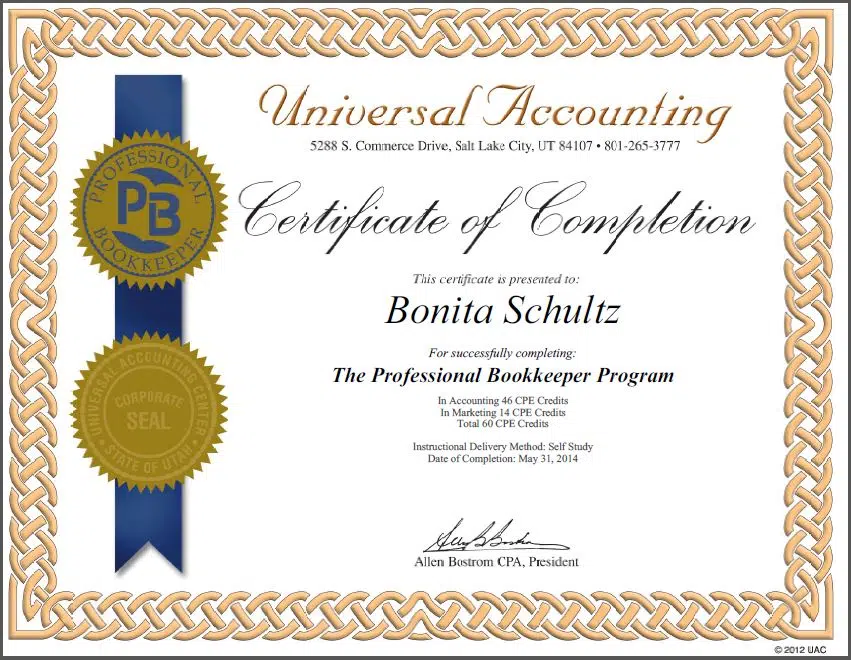
PB CertificateFor more information on the Professional BookkeeperTM Certification Program, and to explore whether home learning with Universal Accounting is right for you, fill out the form on this page.  You’ll receive a free introductory video about the benefits and methods of moving your career forward in accounting & bookkeeping.

Next Page »